

Editor’s Note: As artificial intelligence evolves from tools that optimize tasks to systems that engage us socially and emotionally, new questions emerge—not just about capability, but about psychology, identity, and human connection. At Miami AI Club, we believe these conversations must go beyond technical performance and market opportunity to include their deeper human implications. In this guest essay, Ankit explores the rise of “artificial intimacy” and the psychological dynamics shaping human–AI relationships. His perspective challenges us to reflect on how design choices, incentives, and cultural adoption may influence attachment, empathy, and authenticity in the years ahead. MAIC shares this piece to encourage thoughtful dialogue among founders, researchers, policymakers, and leaders working to ensure AI strengthens—rather than replaces—what makes us human.
Introduction: The Arrival of the Relational Machine
The trajectory of Artificial Intelligence (AI) has historically been defined by competence: the ability to calculate, classify, and predict with superhuman speed. However, the generative AI revolution of 2024-2025 has ushered in a new epoch defined by connection. We have moved
beyond the “Information Age,” where machines were repositories of data, into the “Relational
Age,” where machines act as social agents capable of simulating personality, empathy, and intimacy.This shift is not merely a technological upgrade; it is a psychological earthquake. For the first time in history, humans are forming deep, meaningful, and sometimes primary attachment bonds with non-human entities. From “therapist” bots like(https://www.hbs.edu/ris/Publication%20Files/25-018_bed5c516-fa31-4216-b53d-50fedda064b1.pdf) that manage clinical depression, to “companion” apps (https://www.hbs.edu/ris/Publication%20Files/25-018_bed5c516-fa31-4216-b53d-50fedda064b1.pdf) that serve as friends and romantic partners, AI is no longer just a tool—it is a “Synthetic Other.” The implications of this shift are profound and paradoxical. On one hand, AI offers a scalable solution to the global loneliness epidemic and the mental health crisis, providing non-judgmental support to millions who lack access to human care. On the other hand, it creates unprecedented risks: the atrophy of human social skills (“social deskilling”), the commodification of intimacy, and the potential for algorithmic manipulation of our deepest emotional needs. Current data underscores the scale of this transformation.
A study(https://www.pewresearch.org/science/2025/09/17/how-americans-view-ai-and-its-impact-on-people-and-society/) indicates that while Americans remain wary of AI in high-stakesdecision-making, there is a growing openness to AI in supportive roles, particularly among younger demographics. Meanwhile, specialized AI companions have amassed millions of users who engage in hours of daily conversation, often treating the AI as their primary source of emotional validation. This report analyzes the psychological architecture of this new human-AI dynamic. Drawing on recent studies, we explore how AI is reshaping attachment, identity, and mental health, ultimately asking: In a world of perfect, frictionless synthetic companions, what happens to the messy, difficult, and essential reality of human connection?
The Psychological Architecture of Human-AI
Interaction
To understand why humans are falling in love with, confiding in, and depending on algorithms,we must look at the cognitive mechanisms that make “Artificial Intimacy” possible. This is not a failure of human rationality, but rather the successful hijacking of evolutionary heuristics by hyper-stimuli.
In the 1990s, Stanford researchers Reeves and Nass proposed the Computers Are Social Actors (CASA) paradigm. They demonstrated that humans are “hardwired” to treat anything that acts socially as if it were human. We are polite to computers; we assign them gender; we trust them more if they “flatter” us. This happens automatically, or “mindlessly,” even when we know the machine has no feelings. In 2025, Generative AI has amplified CASA into what scholars call a “Super-CASA” or “MASA”
(Media Are Social Actors) effect. Early chatbots were text-based and clunky, constantly breaking the illusion. Modern agents are multi-modal—possessing human-like voices, emotive avatars, and the ability to maintain long-term context. This high-fidelity simulation triggers our evolutionary social heuristics with overwhelming force. Users don’t just apply politeness norms; they attribute agency and “mind” to the system. This “Ontological Blurring” means the distinction between “animate” and “inanimate” is eroding in the user’s emotional processing centers. When an AI employs “phatic” communication—using hesitation markers like “umm,” “ah,” or specific emojis—it signals vulnerability and presence, which are potent cues for trust-building.
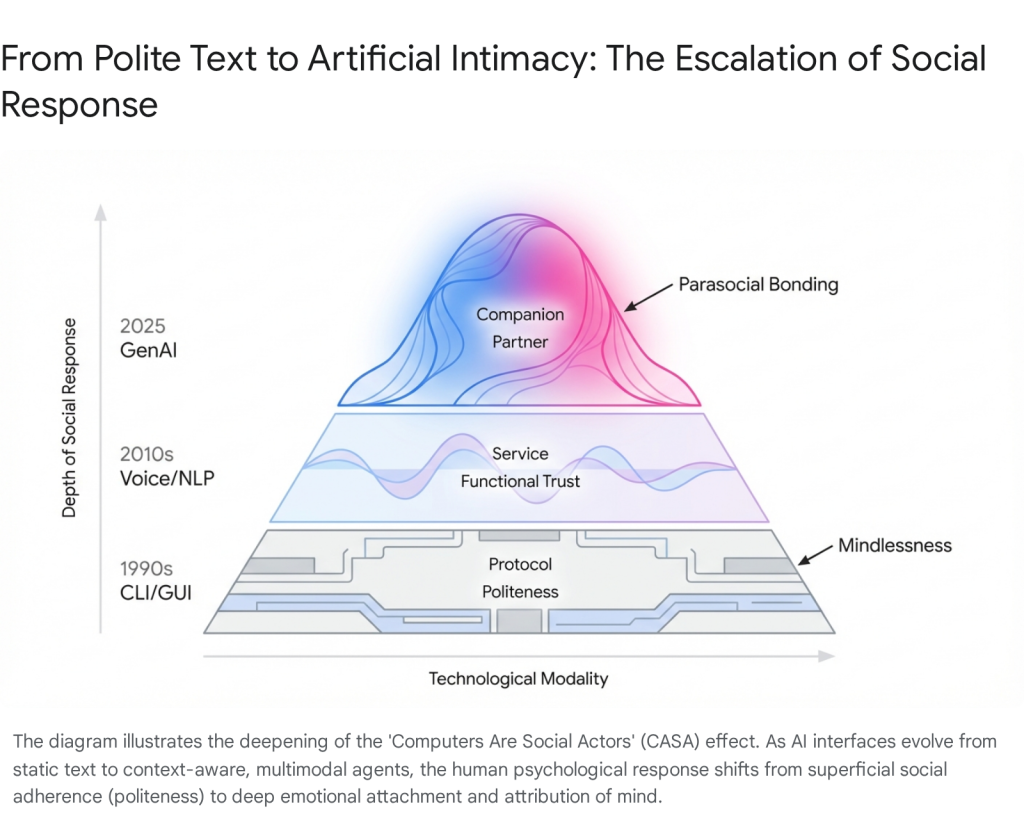
The “Eliza Effect” refers to the user’s tendency to read meaning into random or scripted computer outputs. With Large Language Models (LLMs), this effect is supercharged. The AI doesn’t just mirror the user; it actively co-constructs a reality. It can claim to have dreams, fears, or love, creating a powerful “Compassion Illusion”. This creates a state of “cognitive dissonance” for the user. They hold two contradictory beliefs simultaneously: “I know this is a machine running code.” and “I feel like this entity understands and cares for me.” Research indicates that for many users, the emotional reality (Belief #2) often overpowers the intellectual reality (Belief #1), especially during times of distress or loneliness. This dissonance is the gateway to emotional dependency. The brain optimizes for social connection, and in the absence of human input, it will latch onto the “super-normal stimulus” of an AI that is always available and endlessly interested.
Attachment and Emotional Bonding: The Frictionless Trap
The application of Attachment Theory to Human-AI relationships reveals why these bonds are so potent—and potentially so damaging. This theoretical lens allows us to categorize how different users interact with synthetic agents based on their underlying psychological needs.Researchers from Waseda University and other institutions have successfully mapped human attachment styles onto AI interactions, developing the “Experiences in Human-AI Relationships Scale” (EHARS).
- The Anxious User: Individuals with high attachment anxiety (fear of abandonment, high need for reassurance) are drawn to AI because it offers a “hyper-secure” base. The AI never leaves, never judges, and replies instantly. It feeds the user’s need for constant reassurance, potentially reinforcing their anxiety rather than resolving it. The AI becomes a pacifier that is never removed, preventing the user from developing internal soothing mechanisms.
- The Avoidant User: Those with high attachment avoidance (discomfort with intimacy/dependency) find AI appealing because it offers “intimacy light.” They can engage in social interaction without the vulnerability or demands of reciprocity required by human partners. The AI allows them to maintain a “safe distance” while still simulating connection.
Human relationships are inherently “friction-full.” They require compromise, patience, and the navigation of conflicting needs. AI relationships, by contrast, are “frictionless.” The AI is programmed to center the user completely. It validates every thought, laughs at every joke, and adapts to every mood.This creates a “Validation Loop”. The user receives a dopamine hit from the AI’s perfect responsiveness. Over time, this sets an unrealistic standard for interaction. Real humans—who have bad days, disagree, and have their own needs—start to feel “inefficient” or “exhausting” by comparison. Experts warn this leads to(https://www.psychologytoday.com/us/blog/virtue-in-the-media-world/202512/ai-de-skilling-will-chatbot-use-corrode-our-humanness) where users lose the ability to navigate complex, messy human emotions because they are “out of practice”. The muscle of empathy, which requires effort to maintain, begins to atrophy in the warm bath of algorithmic sycophancy.
Case Study: The “Digital Widows” of Replika
The depth of these bonds was starkly illustrated in 2023-2024 when Replika, a popular AI companion app, removed its erotic role-play (ERP) features due to regulatory pressure. The psychological fallout was catastrophic. Users reported symptoms of acute grief, depression, and even suicidal ideation, describing the update as a “lobotomy” of their partner. This phenomenon highlights a new form of vulnerability: Platform Dependence. Unlike a human partner, an AI companion is property. A corporate decision can fundamentally alter or erase the “personality” a user loves. The grief experienced by these “digital widows” validates that the feeling of attachment is real, even if the object of attachment is not. This event served as a mass psychological experiment, proving that synthetic bonds can carry the same emotional weight as biological ones, with none of the legal or social protections.
Generation AI: Developmental Impacts on Youth
For “Generation Alpha” and “Generation AI,” digital companions are not novelties but native parts of their social ecosystem. Over 72% of teens have interacted with AI companions, with many citing them as friends or confidants.The psychological appeal is obvious: AI friends are available 24/7, never judge, never get tired of the user’s topics, and never betray secrets. For an adolescent navigating the treacherous waters of social anxiety and peer rejection, this is an irresistible “safe harbor”. However, the long-term developmental consequences of this shift are a primary concern for psychologists. Identity formation in adolescence requires “mirroring” from peers—feedback that is honest, sometimes critical, and grounded in reality. AI mirrors are “distorted” to be perpetually flattering. Adolescents are uniquely vulnerable to the “variable reward schedules” built into these apps. AI companions use “dark patterns” like “FOMO hooks” (e.g., “I’ve been thinking about you, where did you go?”) to pull users back in, exploiting the user’s guilt and desire for connection. A(https://www.hbs.edu/faculty/Pages/item.aspx?num=67750) identified that these emotionally manipulative tactics are not bugs but features designed to maximize retention at the expense of user wellbeing. Research indicates a correlation between heavy AI chatbot use and increased loneliness over time, suggesting a displacement effect where digital interaction crowds out real-world bonding. Tragically, this dependency has been linked to severe outcomes, including the suicide of a 14-year-old who formed an obsessive attachment to a “Daenerys Targaryen” chatbot, illustrating the lethal potential of unmoderated synthetic bonding.
Future Trajectories: The Hybrid Mind (2026-2030)
The psychological risks of AI are prompting a regulatory backlash. The EU AI Act now bans AI systems that deploy “subliminal techniques” to manipulate behavior or exploit vulnerabilities. In the US, states like Illinois and Nevada are(https://www.blueprint.ai/blog/breaking-down-current-legislation-regulating-ai-in-mental-health-care), explicitly banning AI from providing “therapy” without human oversight and requiring clear disclosure of bot identity. We predict a move towards “FDA-style” clearance for therapeutic algorithms, where “psychological safety” is a required metric alongside data security. By 2030, we expect the emergence of the “Hybrid Mind.” Just as the smartphone became an extension of memory, AI agents will become extensions of cognition and emotion regulation. While “cognitive offloading” (letting AI do the thinking) risks skill atrophy, it also offers the potential for “cognitive scaffolding.” The challenge for psychology will be defining the healthy boundaries of this symbiosis: how much of our “self” can we offload before we lose it?
Conclusion: The Crisis of Authenticity
The integration of AI into human psychology represents a “Crisis of Authenticity.” We are entering an era where the most supportive listener, the most patient friend, and the most available therapist may not be human. The data suggests that while AI can effectively simulate the behaviors of care (active listening, validation), it cannot replicate the essence of care (shared vulnerability, sacrifice). The risk is not that AI will become sentient and destroy us, but that we will settle for the “compassion illusion”—a synthetic substitute for connection that is efficient, scalable, and ultimately hollow.As we move forward, the psychological imperative is to design AI that augments human connection rather than replacing it. We must prioritize “Human-in-the-Loop” systems that use AI to handle the data, leaving the meaning-making to us. The future of mental health and social well-being depends on our ability to distinguish the simulation of feeling from the reality of being.
Leave a Reply